


Buying an EV? Solar Canopies and the EV Boom
Electric vehicles (EVs) are the next generation of vehicles designed to run solely on electricity. They are becoming increasingly popular not only among consumers trying to reduce their fuel consumption and be environmentally conscious, but also among those looking to make the most of their solar power investments by lowering costs.
If you are considering making the switch and investing in an EV for your personal use – or even electrifying your business’s fleet – this is a major decision that comes with important considerations.
Electric vehicles can dramatically increase your electricity use, with some estimates noting that you could pay between $30 and $60 extra on your monthly electric bill simply to power your vehicle. This expense may be lower than the average price of gas, but it could still add pressure to your finances. Solar canopy EV charging stations provide a workable solution.
A solar canopy, and even commercial solar canopies, may be significantly less costly to install than a standard solar set-up on your home or business facility’s roof. At the same time, these canopies will offer notable benefits and electrical power cost savings over time. They can also provide a tailored solution for EV charging, allowing you to power your vehicle efficiently and consistently without relying on the grid.
Read on as we explore how solar canopies with EV charging station models work and how they provide the perfect solution for charging this new generation of vehicles.
How Solar Canopies Can Benefit Your EV Purchase
According to Tech Report, the EV market share in the US in 2023 was 7.6%. This was a 1.7% increase over 2022. In 2024, the market is expected to reach a value of $82.8 billion, demonstrating significant growth and demand from consumers.
As of the first half of 2023, statistics show that 18% of all cars in the United States were electric (2.88 million in total), and by 2028, consumers are expected to have purchased a further 2.46 million electric vehicles. Tesla is currently the market leader in the US, holding a majority market share of 55.1% in 2024.
The benefits of EVs are myriad. Their working parts are simpler than conventional petrol and diesel vehicles, making them more reliable and ensuring that they require less maintenance and part replacement. This can help to keep maintenance expenses low. They also do not contribute towards air pollution by producing exhaust fumes, and when powered by solar electricity, do not contribute towards the burning of fossil fuels to produce electrical power. Electric vehicles are exceptionally quiet on the roads, which helps to minimize noise pollution. Plus, they are generally affordable to own and run, after the initial purchase.
Additionally, these vehicles are highly practical in several keyways. Although they require a certain amount of space for their battery cells, these cells can be laid out flat along the base of the vehicle. This reduces the space needed for large engines and transmissions and frees up more interior space for passengers and cargo.
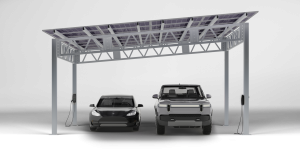
They can also be charged at home, eliminating the need for dedicated trips to gas stations to refuel. EVs can be charged from a wall socket in your garage or even using a residential solar carport EV charging station, allowing you to start each trip with a ‘full tank’. Although you may need to plan carefully to ensure that your vehicle batteries do not run out during long trips you will seldom need to take your electric vehicle to a charging station as part of your daily routine.
EV Charging Requirements and Charging Capabilities of Solar Canopies
All electric vehicles require charging to function. Most experts recommend using a 240-volt charging port for quicker and more efficient charging. Electrical usage for EVs is measured in kilowatt hours (kWh). One kilowatt (kW) is equal to 1,000 watts (W), and kWh is a measurement of the number of kilowatts used each hour.
The battery capacities of modern electric vehicles vary widely depending on the size, make, and model of each vehicle. Smaller EV models like the Mini Cooper SE have battery sizes of only 30kWh, while larger and more powerful vehicles like the GMC Hummer EV can have sizes of over 200kWh. The size of the battery is simply an indication of how much electricity it can store; the efficiency of your EV and how far and often you drive will determine the overall energy consumption of your electric vehicle.
The Environmental Protection Agency uses a specialized rating to assess the efficiency of EVs. This efficiency is measured in kWh used per 100 miles. All electric vehicle ratings will be listed on the official website of the Department of Energy, as well as the window sticker of your EV. You may also notice a measurement in miles per gallon equivalent (MPGe). This is a converted estimate of your vehicle’s electricity usage to the miles per gallon measurement used to assess the efficiency of gas and diesel vehicles.
The efficiency of electric vehicles also varies considerably. More economical vehicles may use around 25kWh per 100 miles driven, while larger and more powerful vehicles, including pickup trucks, may use 60kWh per 100 miles driven or more. We will use these two efficiency rating estimates in the cost evaluation example below.
Assessing Solar Canopy EV Charging Savings with an Example
As a solar canopy installer, it’s important to be able to demonstrate to your clients how they can benefit practically and financially from investing in a Brooklyn Solar canopy. The practical benefits of a solar carport for parking lots include at-home EV charging and carport protection for vehicles to guard them against the elements – but there are cost saving benefits as well.
In our example, we’ll use the BSCC A-Frame solar canopy to enable you to calculate your customers potential cost savings and payback periods with solar canopy EV charging stations.
In our example, the customer has chosen an A-Frame solar canopy with a 3×7 solar panel layout, making for a total of 21 solar panels generating 400W each. This solar carport will generally cost between $11,000 and $12,000, depending on the client’s preferred finishes and their location of delivery and installation. We will use the higher cost of a solar canopy figure of $12,000 for the calculation.
The estimated average cost of solar panels in the US is $2.94 per watt, meaning that a single 400W panel could cost around $1,176, and the client’s full complement of 21 panels will cost $24,696, according to this estimate. We will also take the example of a client living in California – an area with a high solar power production ratio – and connect their 21 panels to an 8kW power system. The price of solar panels in California is higher than the average mentioned above at $2.86 per watt, meaning that in this specific area, the 21 panels will cost $24,024.
The average Californian electricity cost per kilowatt hour (kWh) stands at 26.72cents. If this client were to also invest in an electric vehicle and wants to know how much they will pay in electricity on a standard grid system, this can be calculated using the following formula:
Vehicle’s kWh per mile estimate * miles driven on average * cost of electricity per kWh = cost of running an EV
So, if an EV uses 0.5kWh per mile and your customer drives an average of 12,000 miles per year, the EV will use 6,000kWh per year. If the customer charges the EV at home using standard grid electricity and is being charged 26.72cents per kWh, the vehicle will cost around $1,603.20 to charge at home each year.
The formula will appear as follows:
0.5kWh * 12,000 * 0.2672 = $1,603.20

Energy Bill Savings with Solar Canopy Stations
Now, referring to the solar system example above, if you add the customer’s solar panel expenses at $24,024 with the $12,000 cost of purchasing their solar awning, the total cost price will come to $36,024. Add your 20% (on average) labor fee for installation, and the client’s total expenses for investing in their solar system will amount to $43,228.80.
If the client’s EV uses 6,000kWh of power per year, a solar pergola system of this size would produce enough energy to power the EV. Plus it would provide an additional 6,000kWh of power per year for residential consumption. Moreover, if the client would be spending $1,603.20 per year on powering their EV and a further $1,603.20 on household electricity at 6,000kWh per year for a small household, their average yearly electricity expenses would equal $3,206.40.
Now we can calculate the full cost of the EV charging solar carport installation as a percentage of this customer’s annual expenditure on grid power to assess their potential savings.
Installing a backyard solar canopy system with 21 panels at specified rates for California would ‘pay off’ the customer’s annual electrical bills in roughly 13.48 years, while enabling them to enjoy the many benefits offered by electric vehicles and solar carport EV charging stations alike.
Power Your EV with a Brooklyn Solar Canopy
BSCC’s solar canopy models and solar canopies with battery storage can facilitate seamless EV charging at home using clean solar energy. At the same time, it helps customers to reap the cost savings and practical benefits of modern electric vehicles.
Get a quote for a solar canopy or a solar carport for an EV today. As an installer, you can help your customers make the switch towards environmentally friendly technologies that make travel simpler, more cost efficient, and more sustainable.