


Qualify for the 10% Domestic Content Adder for Commercial Projects
As a solar canopy installer, it’s in your best interests to know about the Domestic Content Adder and how it can benefit your business and clients. This provision of the US Inflation Reduction Act has been designed to encourage installers to use domestically produced materials when constructing their solar projects.
Solar canopy product installations are a core focus of the 10% Domestic Content Adder, but the provision also extends to a wide range of clean power project types. If you and your project meet its requirements, your client may be able to claim a larger tax credit to maximize their savings.
Read on as we outline exactly how to obtain the 10% Domestic Content Adder. We’ll explain how it can benefit you as an installer and your commercial-scale solar canopy clients. We also examine how purchasing an aluminum solar carport from Brooklyn Solar Canopy Co. can qualify your next solar project for a reduction.
What is the 10% Domestic Content Adder?
The 10% Domestic Content Adder is legislature included in the 2022 Inflation Reduction Act (IRA), a groundbreaking set of energy and climate mitigation laws. These laws have been designed to accelerate the expansion of renewable energy systems by incentivizing organizations and business owners to adopt renewable energy systems at scale while reducing the associated expenses.
The IRA offers a range of different clean energy tax credits for solar canopies. These credits include the Domestic Content Adder, also known as the Domestic Content Bonus Credit, and others, such as the Energy Communities Bonus Credit. The 10% tax incentive is compelling for any property or business owner looking to invest in solar canopies and solar energy systems. That said, it has strict qualification rules, and installers and clients must meet these to claim it.
How Does the Domestic Content Adder Work?
The 10% Domestic Content Adder applies to solar energy project developers. It offers project owners two key incentives: a Production Tax Credit Adder applied per kW of energy produced, or a 10% Investment Tax Credit Adder (ITC). Commercial solar carport projects tend to benefit the most from the Investment Tax Credit Adder, as it offers increased average take-off rates for large-scale commercial and community projects.
To take advantage of the adder, all structural components in your solar carport installation projects must be produced 100% domestically in the US. Any manufactured components should consist of at least 40% or more domestically produced materials.
There is a distinction to be made between manufactured and structural products when applying for the credit. In terms of structural components, these include materials such as aluminum within racking materials. This aluminum must be completely manufactured in the United States to qualify your project.
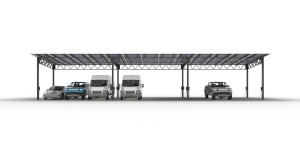
Other structural components include full rooftop solar racking systems, aluminum fixed tilt racking systems, and ground screws used in ground-mounted racking structures like BSCC’s customer parking solar canopy products. If the racking system you’re installing is manufactured from US made aluminum, it is classified as a manufactured product.
Manufactured products and components encompass all the other elements in your project that are not considered to be structural in nature. However, as mentioned above, any racking systems made from aluminum are manufactured products. In these cases, the constituents of these materials will determine your project’s domestic content percentage.
Applying the Tax Bonus to Your Project
The Domestic Content Bonus applies to several distinct tax credit statutes and categories. The applicable statutes are:
- Energy storage and generation facilities that are eligible for ITCs.
- Facilities that qualify for PTCs.
- Qualifying investments in zero greenhouse-gas emitting energy storage and generation facilities that receive tech-neutral ITCs.
Updating or upgrading existing solar energy projects also qualify for the tax credits for solar canopies, provided they fall into one of these categories. The IRA also specifies an ‘80-20 rule’, which stipulates that a maximum of 20% of the value of a clean energy project may consist of existing equipment. Any new equipment or structures you use in these upgrade projects must align with domestic content rules for your client and project owner to receive the tax credit.
Understanding Adjusted Percentages
Taxpayers who want to qualify for the bonus must construct projects using 100% US-produced aluminum, steel, and iron. To be eligible, these parties must also use the appropriate adjusted percentage of domestically manufactured products. These percentages are as follows:
- 40% for any solar energy installation projects that started construction before January 1, 2025.
- 45% for projects that started construction between January 1, 2025, and December 31, 2026.
- 50% for renewable solar power projects starting construction between January 1, 2026, and December 31, 2027.
- 55% for installation projects commencing construction from January 1, 2027, onward.
Renewable projects that meet all of these stipulations will be eligible for higher credit values, including 10% increases in ITC and PTC values. However, your project must also meet certain apprenticeship and wage regulations before it can qualify.
Benefits for Your Solar Canopy Clients
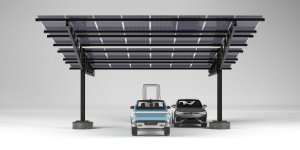
The 10% Domestic Content Adder can significantly benefit your commercial clients. Project owners can notably increase the ROI of their commercial solar investments through the adder. This can make solar installations more cost-effective and economically viable. In turn, this may bring you an increased number of customers and projects.
When you install high-quality, domestically manufactured solar structure products, you can also ensure that your clients receive durable, long-wearing systems that perform as advertised. This can enhance your clients’ solar carports’ long-term financial and functional value, further increasing their financial benefit.
The Domestic Content Adder has been designed to offer direct tax incentives to commercial parties. This means that organizations, businesses, and commercial entities that approach you for their installation needs can enjoy financial incentives directly. Residential property owners typically do not qualify. In cases of residential solar projects owned by third parties, however, project owners may still be awarded the 10% bonus.
How BSCC Solar Canopies Qualify
Brooklyn Solar Canopy Co.’s aluminum solar canopies will qualify your commercial projects for the 10% Domestic Content Adder. Our solar canopy manufacturing and fabrication processes are carried out in the United States.
All our products are fabricated in Providence, Rhode Island, with high-quality, corrosion-resistant aluminum. This material forges a sturdy and resilient canopy design that can maintain its structural integrity for decades.
Our aluminum canopies also automatically qualify for the 10% Domestic Content Adder, unlike metal solar carport structures crafted from steel and other materials.
If you wish to apply for the Domestic Content Bonus, contact one of our BSCC representatives, and we’ll provide you with a letter from our legal counsel.
Secure Your Client’s Tax Bonus with Brooklyn Solar Canopy Co.
BSCC’s durable solar canopies will qualify your commercial installation projects for the IRA’s 10% Domestic Content Adder. This qualification can provide your clients and project owners with significant savings on their professional solar canopy installation, ensuring they secure clean, renewable power generation systems for their facilities and operations.
Speak to our team today to learn more about qualifying your next installation venture for the 10% Domestic Content Adder.